
Join over 5M+ verified members worldwide and start connecting today in a privacy-first, respectful dating environment.
Join over 5M+ verified members worldwide and start connecting today in a privacy-first, respectful dating environment.
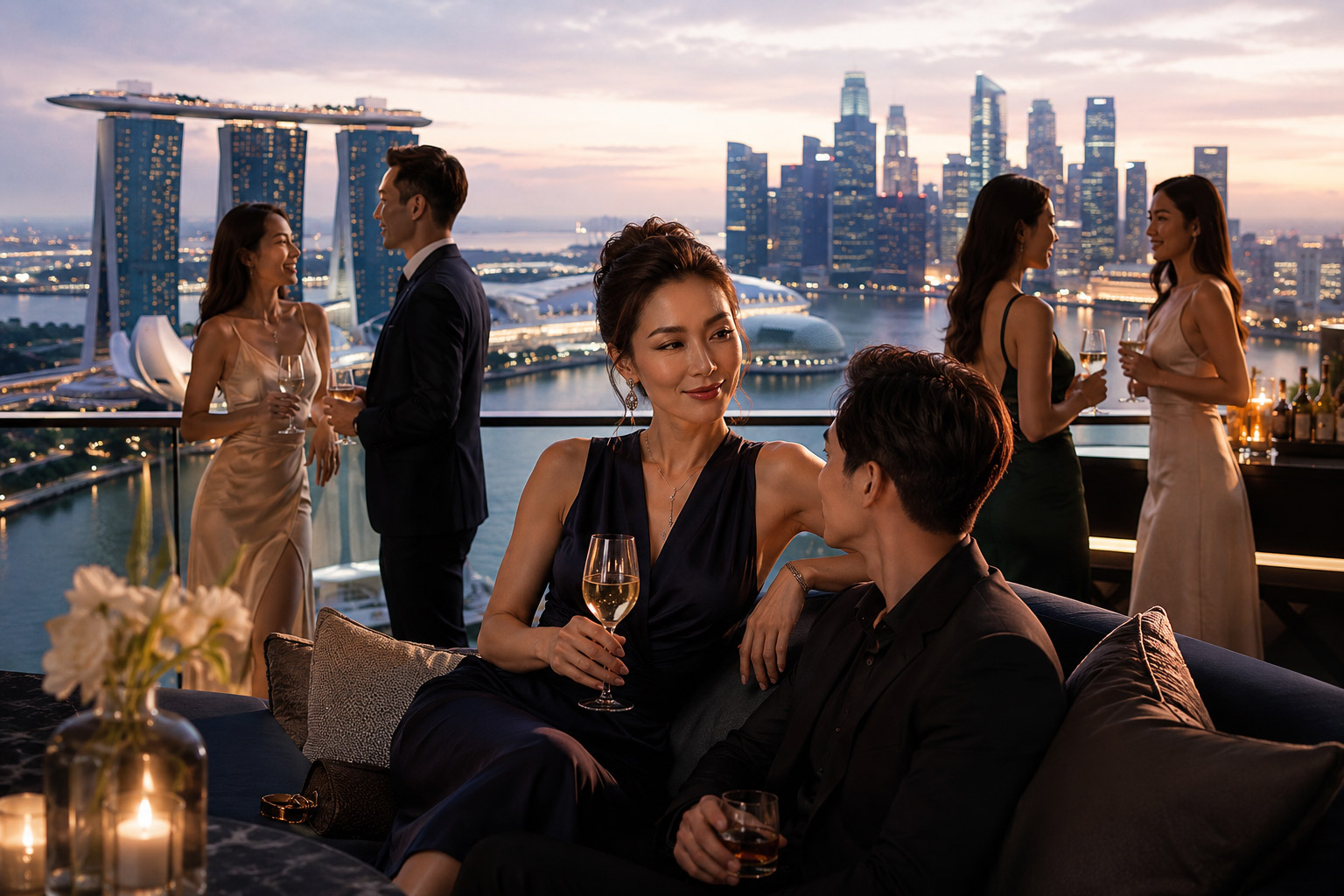
The rhythm of social life in Singapore often reflects the city's business districts. Around Marina Bay and Raffles Place on weekday mornings, professionals move between financial institutions, multinational headquarters, legal offices, and technology firms before regional markets fully open. Later in the evening, restaurants and hotel lounges near the waterfront attract executives, consultants, entrepreneurs, healthcare specialists, and international professionals meeting colleagues, clients, or friends after work.
Much of Singapore's professional community is concentrated within areas such as Marina Bay, Shenton Way, Tanjong Pagar, Orchard Road, and the Central Business District. As a result, career development is often part of everyday conversation. Discussions frequently begin with business projects, industry trends, international travel, education, or future plans before becoming more personal. In a city where many residents work in finance, technology, healthcare, law, logistics, and regional management roles, professional achievement is generally viewed as a normal part of adult life rather than a defining characteristic.
For those researching Sugar Mummy Singapore, local dating dynamics are often more complex than internet stereotypes suggest. Many successful women in Singapore have spent years building careers, leading organizations, managing investments, operating businesses, or developing expertise within highly competitive industries. Personal connections are commonly influenced by factors such as communication style, reliability, shared values, lifestyle compatibility, and long-term goals. Trust tends to develop gradually, particularly among professionals balancing demanding schedules with active social lives.
Singapore's dating landscape is shaped by a combination of economic stability, international mobility, and one of the highest concentrations of skilled professionals in Southeast Asia. As a major financial and business center, the city attracts executives, entrepreneurs, legal professionals, healthcare specialists, technology leaders, and investors from around the world. Daily life often revolves around work, professional networks, and carefully balanced personal schedules.
The influence of industries such as finance in Marina Bay, technology and startups around One-North, international trade near the Central Business District, and multinational corporate headquarters throughout Downtown Core creates a large population of career-focused singles. Many professionals manage regional responsibilities across ASEAN markets, frequently traveling between Singapore, Hong Kong, Tokyo, Sydney, and other business hubs.
Neighborhoods including Orchard Road, River Valley, Holland Village, Tanjong Pagar, Keppel Bay, Bukit Timah, and Robertson Quay are often associated with established professionals and internationally minded residents. Social interactions commonly take place through business events, private networking gatherings, fitness communities, cultural exhibitions, fine dining venues, and waterfront lifestyle districts rather than traditional nightlife alone.
Singapore's multicultural population also contributes to a distinctive social environment. Chinese, Malay, Indian, Eurasian, and expatriate communities interact within the same city while maintaining their own cultural traditions and social networks. As a result, successful relationships often depend on communication skills, cultural awareness, long-term compatibility, and mutual respect for professional ambitions.
For many professionals living in Singapore, trust is built gradually. Career achievements may open introductions, but qualities such as consistency, emotional maturity, discretion, and reliability tend to play a larger role in developing meaningful connections over time.
Marina Bay sits at the center of Singapore's financial and corporate landscape. The district connects directly with Downtown Core, Raffles Place, and Shenton Way, creating one of the highest concentrations of finance, technology, legal, and multinational business activity in Southeast Asia.
On weekday mornings, the pedestrian routes surrounding Marina Bay often fill with professionals moving between office towers, client meetings, and regional headquarters. Many of Singapore's decision-makers and senior executives work within a relatively compact area, contributing to a highly networked business environment.
Women commonly working in and around Marina Bay include:
Professional networking remains a visible part of daily life in the district. Industry conferences, executive roundtables, business association events, fundraising galas, and client dinners regularly bring together professionals from finance, technology, healthcare, logistics, and international commerce.
Unlike entertainment-focused social environments, many interactions in Marina Bay begin through professional introductions, industry events, or shared business networks. Educational background, career achievements, communication skills, and international experience often play a significant role in how new connections develop.
Many established professionals working in Marina Bay maintain schedules shaped by regional responsibilities, overseas travel, and demanding project timelines. As a result, reliability, punctuality, and clear communication are generally valued qualities when building relationships within these circles.
The district's international character also contributes to a diverse social environment. Professionals from Singapore, Europe, North America, Australia, China, India, and other parts of Asia frequently work side by side, creating a multicultural setting where cross-cultural awareness and adaptability are often appreciated.
To many visitors, Orchard Road is Singapore's premier shopping destination. For local professionals, however, the district serves a broader role. Office towers, luxury hotels, private clubs, and business venues around Orchard Road create an environment where professional and social networks frequently intersect outside traditional workplaces.
On weekday evenings, it is common to see business discussions continue after office hours in hotel lounges, executive dining venues, and private event spaces. Professionals working in nearby areas such as Tanglin, River Valley, Newton, and the Central Business District often use Orchard Road as a convenient meeting point due to its accessibility via Orchard MRT and its concentration of hospitality venues.
Women active within these professional circles often hold leadership or specialist positions across Singapore's major industries. Common professional backgrounds include:
Many have educational backgrounds connected to institutions such as the National University of Singapore (NUS), Nanyang Technological University (NTU), Singapore Management University (SMU), or international universities in the United Kingdom, Australia, Europe, and North America. International experience is common, particularly among professionals managing cross-border teams or regional business units.
Unlike networking environments built primarily around nightlife, social interactions in Orchard Road often develop through professional introductions, industry events, alumni communities, leadership programs, charitable initiatives, and long-established business relationships. Reputation, credibility, and communication skills tend to carry significant weight within these circles.
The area's proximity to luxury hotels, premium residences, and corporate offices attracts a steady mix of local executives, expatriate professionals, entrepreneurs, and senior managers. As a result, Orchard Road remains one of the locations where Singapore's professional community regularly overlaps with its broader social landscape.
Sentosa Cove occupies a distinct position within Singapore’s residential geography. The area is built around waterfront villas, private berths, and marina-facing properties, creating a living environment that feels physically separated from the high-density rhythm of the Central Business District.
Daily life in Sentosa Cove tends to be structured around privacy and controlled access. Gated residential clusters, low pedestrian traffic, and direct waterfront orientation shape a social setting where interactions are more selective and less incidental than in most urban neighborhoods across Singapore.
Residents in this zone are frequently associated with international business activity, including company founders, investment professionals, senior corporate executives, and globally mobile specialists. Many split their time across multiple financial centers, which influences how social relationships are formed and maintained locally.
Social interaction in Sentosa Cove is less dependent on public venues and more connected to private channels: marina clubs, yacht ownership groups, private dining plans, and invitation-only gatherings. These environments tend to prioritize discretion, familiarity, and long-term reputation within small networks.
Keppel Bay shares a similar residential logic, though with a slightly more integrated waterfront design. Its proximity to HarbourFront and the southern coastline places it closer to commercial infrastructure, while still maintaining a controlled residential atmosphere.
In both Sentosa Cove and Keppel Bay, trust is a central social factor. Because introductions often occur through existing networks rather than open public settings, personal credibility and consistency in behavior carry more weight than surface-level impressions.
These neighborhoods reflect a broader pattern seen in high-density global cities like Singapore: as residential exclusivity increases, social ecosystems become smaller, more interconnected, and more dependent on reputation continuity rather than spontaneous encounters.
River Valley, Robertson Quay, and the Singapore River corridor sit within one of Singapore’s most established residential and lifestyle belts, positioned between the Central Business District and Orchard Road. The area is closely connected to major commercial hubs such as Raffles Place and Marina Bay, which shapes its resident profile toward finance, consulting, technology, and regional corporate leadership roles.
Housing in this district is typically occupied by mid-to-senior level professionals working in multinational companies, investment firms, and advisory services. Daily routines often reflect a structured urban lifestyle—early commutes into the CBD, evening returns along the river, and frequent use of nearby dining and fitness facilities.
Robertson Quay in particular has developed into a low-density riverside dining zone, where waterfront restaurants, boutique gyms, and quiet cafés create a consistent but understated social environment. Unlike entertainment-heavy districts, activity here is more predictable and routine-driven, often centered around post-work dinners and small group gatherings rather than large-scale nightlife.
River Valley Road connects these residential clusters to Orchard, forming a corridor where expatriate professionals, regional executives, and long-term residents intersect. This contributes to a socially international but relatively privacy-conscious community structure, where introductions often occur through work networks, fitness communities, or mutual professional contacts.
Weekend patterns in the area tend to be lifestyle-oriented rather than event-driven. Morning runs along the Singapore River, brunch at Robertson Quay, Pilates or gym sessions in private studios, and informal networking lunches are common. These activities reflect a preference for consistency and personal balance rather than high-visibility social engagement.
From an EEAT perspective, the River Valley–Robertson Quay–Singapore River district demonstrates a clear link between urban geography and professional demographics: proximity to the CBD supports high-skill employment concentration, while residential planning along the river promotes a stable, long-term expatriate and executive population profile.
Holland Village sits at the intersection of long-established residential streets and a steady expatriate community that rotates through Singapore’s academic, consulting, and regional corporate sectors. The area is known for its walkable dining lanes, small independent cafés, and informal evening social rhythm that develops around conversation rather than structured networking. Compared to the Marina Bay financial district, the pace here feels less performance-driven and more rooted in everyday social continuity.
Bukit Timah, in contrast, reflects one of Singapore’s most established residential corridors, shaped by decades of upper-middle and high-income family settlement. The presence of international schools, private clubs, and long-standing community institutions creates a stable social ecosystem where many residents have deep local ties. Professionals in this district often work in law, finance, medicine, academia, or multinational leadership roles, but their daily environment is anchored in residential routines rather than commercial visibility.
Across both Holland Village and Bukit Timah, relationship dynamics tend to form gradually through repeated social exposure rather than rapid introductions. Common priorities include long-term compatibility, education alignment, lifestyle consistency, and practical planning around work and family structure. Conversations in these districts often reflect a preference for measured decision-making and lower social volatility, particularly among established professionals balancing regional or international careers.
Across Marina Bay, Orchard Road, Tanjong Pagar, River Valley, Holland Village, and Bukit Timah, professional women are commonly concentrated in sectors closely tied to Singapore’s role as a global financial and commercial hub. These areas are closely connected to major business districts, international schools, and high-density residential zones where senior professionals often live or work.
Many of these professionals hold roles that require regional oversight across Southeast Asia, cross-border coordination, and high-level decision-making in fast-paced environments. Their work often involves managing multi-market portfolios, leading distributed teams, or advising on regulatory, financial, and technological strategy.
Within these professional environments, reliability and consistency are often viewed as essential traits rather than optional qualities. While ambition and career progression are widely present, long-term professional trust tends to be shaped more by clarity in communication, ethical conduct, and the ability to maintain stable performance under pressure.
In Singapore’s urban environment—particularly across areas such as Marina Bay, Raffles Place, Tanjong Pagar, and Orchard—social and professional interactions often overlap. While the city maintains a strong reputation for public safety, personal discretion and structured caution remain standard practice in modern dating contexts.
Individuals working in finance, technology, consulting, and multinational organizations often operate within tightly connected professional networks. In these environments, reputation management and privacy awareness are treated as practical considerations rather than optional preferences.
In Singapore’s professional culture, particularly within high-density corporate districts like Raffles Place and Marina Bay Financial Centre, discretion is often considered part of personal credibility. Demonstrating awareness of privacy boundaries is commonly interpreted as a sign of social maturity and professional alignment.
In Singapore, professional and executive-level residents are often concentrated in districts such as Marina Bay, Orchard Road, Tanjong Pagar, River Valley, Sentosa Cove, Bukit Timah, Holland Village, Robertson Quay, Singapore River, and Keppel Bay. These areas are closely linked to corporate headquarters, luxury residences, international schools, and waterfront lifestyle developments, which naturally attract finance professionals, entrepreneurs, and regional business leaders.
Singapore’s social environment is shaped by a strong international workforce. Many professionals come from Europe, North America, China, India, and neighboring Southeast Asian countries. This creates mixed cultural expectations in dating, where communication style, career background, and lifestyle compatibility often matter as much as shared nationality or local familiarity.
Many professional women in Singapore work in sectors such as banking, technology, healthcare, consulting, law, and multinational corporate management. These roles often involve long working hours, regional travel across Asia-Pacific, and high-performance expectations. As a result, flexibility, clear communication, and respect for time commitments tend to play an important role in how relationships develop.
Privacy is a key cultural expectation in Singapore, especially among executives, investors, founders, and professionals in regulated industries. Social reputation and professional credibility are closely connected, so discretion is generally valued. People often prefer low-profile social settings such as private dining rooms, members’ clubs, or quiet cafés when getting to know someone new.
It is generally recommended to meet in public and well-established locations such as central dining areas or hotel lounges during initial meetings. Verifying identities through consistent communication, avoiding financial requests, and setting clear expectations early are standard safety practices. Many residents also prefer gradual in-person progression after initial video or messaging conversations to ensure mutual trust.