
Join over 5M+ verified members worldwide and start connecting today in a privacy-first, respectful dating environment.
Join over 5M+ verified members worldwide and start connecting today in a privacy-first, respectful dating environment.
Late afternoon in Cardiff moves at its own pace. Around St Mary Street and the surrounding city center, office workers and professionals linger rather than scatter immediately after the day ends. Conversations spill onto café terraces, small galleries, and boutique shops, creating subtle networks of repeated encounters that shape local social dynamics. The compact urban layout makes the city feel smaller than its map suggests, allowing connections to emerge naturally through proximity and routine.
In Cardiff, Wales, the term “Sugar Mummy Cardiff” may appear in searches, yet the reality is embedded in a broader social fabric. Local professionals, entrepreneurs, and culturally engaged residents often meet multiple times across familiar streets, public spaces, and weekend events before meaningful rapport develops. Observing these patterns emphasizes discretion, mutual respect, and awareness of personal safety in social interactions.
Understanding local social patterns here is less about high-volume interactions and more about repeated, reliable encounters. Thursdays through Sundays show the densest social overlap: evening networking in Castle Quarter, gallery openings near Roath, riverside cafés along the Taff, and weekend markets. Familiarity builds gradually, offering context for trust while respecting privacy and professional boundaries.
Cardiff’s social geography is compact, and that shapes how introductions happen among young professionals. In practice, most routines orbit a few repeat locations rather than spreading across the wider city. This density creates familiarity over time—people tend to recognise faces quickly, even without formal introductions.
What stands out locally is how short the distance is between weekday life and weekend social life. A weekday coffee spot can become a Friday night meeting point. That continuity reduces anonymity and increases informal social accountability.
Across Cardiff city centre, nightlife areas don’t function in isolation. They form a connected loop rather than separate districts. People often move between them in a single evening, which increases cross-area familiarity and reduces the “fragmented city” effect seen in larger urban environments. That overlap is part of what makes social connections feel faster and more repetitive in practice.
St Mary Street transforms entirely after dark, especially on Friday and Saturday nights. The street becomes the nucleus of Cardiff’s weekend social activity, where the energy shifts quickly and visibly rather than gradually.
Groups arrive together, but interactions often extend beyond familiar circles. Observers note that first encounters happen rapidly, facilitated by the high density of people and open social atmosphere.
Professional individuals, including finance and legal specialists working in Cardiff, are part of this scene, though nothing about them is immediately obvious. Dress codes are relaxed compared with London or other major cities, and social cues are often understated, requiring attention to subtle signals.
Initial introductions occur quickly, yet meaningful engagement tends to develop later in quieter venues—restaurants, lounges, or smaller bars—where conversation can be more focused and private.
Mill Lane in Cardiff offers a distinctive social rhythm. The bars are smaller, the spaces closer, and interactions happen in tight quarters. Over the course of an evening, recurring faces become noticeable, forming a network of habitual presence.
Within the city centre, Cardiff social circles converge here more than elsewhere. A single introduction often branches into indirect connections, linking several groups across the area.
Familiarity grows quickly. Not through lengthy conversations, but through repeated brief encounters that establish recognition and trust over time.
Observing affluent female professionals in Cardiff reveals subtle patterns of influence. Leadership, decision-making, and the tempo of interactions become apparent — not through overt dialogue, but through habitual social cues and consistent engagement across evenings.
For those navigating professional and high-value social spaces in Cardiff, these dynamics highlight how repeated interactions shape perceptions and opportunities in local networking environments.
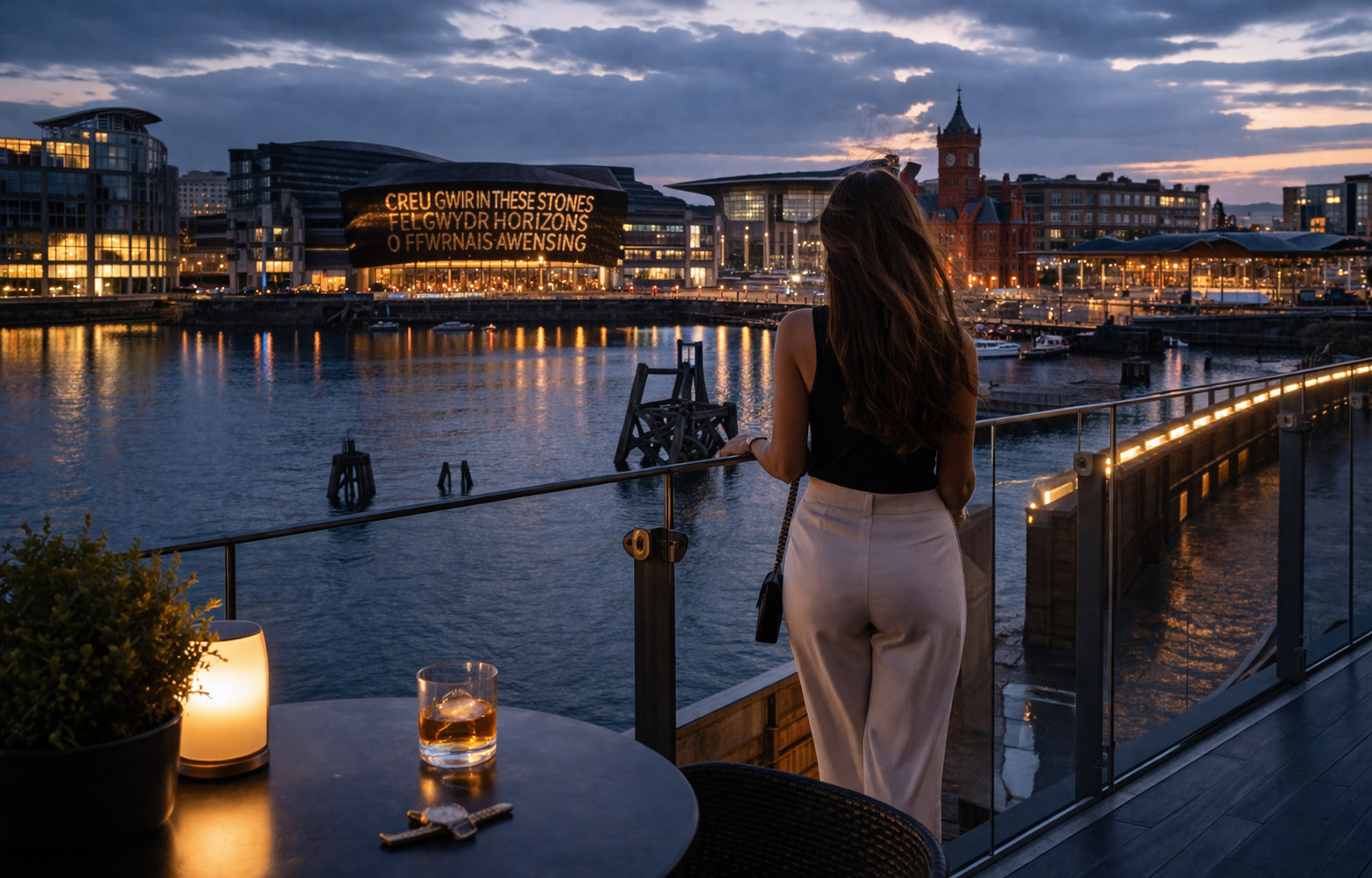
Cardiff Bay presents a contrast to the faster pace of the city centre. Here, conversations unfold more slowly, giving space for genuine interaction.
Daytime socializing often occurs in waterfront cafés, bistros, and boutique eateries. The area reflects the local habit of relaxed brunch culture—subtle, consistent, and embedded in everyday life rather than staged for appearance.
For young professionals living and working in Cardiff, the Bay provides a setting where connections are measured and considered. Meetings tend to focus on meaningful dialogue rather than fleeting impressions.
When relationships extend beyond evening events or nightlife, Cardiff Bay often becomes the natural location for continued interactions, blending the local waterfront lifestyle with professional routines.
Roath is often understated on the map of Cardiff’s social scene, but it quietly supports meaningful connections. Its residential streets, lined with early 20th-century houses and modern apartments, create spaces where locals live rather than just pass through.
Coffee shops, small galleries, and boutique cafés here attract professionals and creatives alike. Casual meetups feel integrated into daily routines rather than staged social events, giving interactions a natural and authentic rhythm.
The area demonstrates a form of approachable luxury. Interiors are thoughtfully designed, menus reflect artisanal attention, and the atmosphere exudes quiet confidence without ostentation. For anyone navigating Cardiff’s dating scene, Roath offers a low-key, credible environment for building rapport.
Interactions tend to be more deliberate — conversations are often uninterrupted, environments are calm, and social cues are subtler than in the busier central districts.
Cathays carries the energy of Cardiff University and the surrounding student population. Younger demographics, early-career professionals, and international students converge here, creating a dynamic social mix that shapes local behaviour.
Relationships in Cathays often start casually, influenced by shared academic or creative pursuits. The proximity of study, work, and leisure spaces facilitates natural connections that can extend into wider city life.
Even beyond Cathays, the university-driven energy subtly permeates Cardiff’s cafés, bars, and cultural venues, affecting daytime routines and evening social interactions alike. For professionals or visitors looking for authentic engagement, understanding this local rhythm provides an informed perspective on the city’s social landscape.
Cardiff behaves differently from larger UK cities like London when it comes to social and dating dynamics. The city’s scale compresses interaction patterns — not in an abstract way, but in a practical, lived sense shaped by geography, transport routes, and repeat social exposure across familiar venues.
In areas like Cardiff Bay, Pontcanna, and the city centre around St Mary Street, people often cross paths more than once without planning it. A first meeting rarely stays isolated. The same individuals tend to reappear in similar spaces — cafés, gyms, riverside walks, or weekend venues near the Bay — which naturally creates recognition over time.
This repetition subtly shifts behaviour. Interactions tend to carry more continuity. Even brief encounters can develop into ongoing familiarity, which makes social signalling more deliberate and less disposable compared to larger, more anonymous cities.
In Cardiff, discretion is less about formal rules and more about spatial awareness. The city is small enough that social, professional, and lifestyle circles often overlap, particularly between the city centre, Roath, and Cardiff Bay business districts.
This structure is not formalized, but emerges naturally from how often people re-encounter each other across the same limited set of urban spaces.
In practice, private relationships in Cardiff require an awareness of visibility. Even casual interactions can become socially traceable due to shared venues, mutual acquaintances, and overlapping professional networks in a relatively compact city environment.
In Cardiff, Wales, the relationship between cost of living and lifestyle is shaped by relatively accessible urban pricing compared to larger UK cities. Areas close to the city centre—such as Cardiff Bay, Pontcanna, and Roath—tend to attract a mix of professionals, students, and public sector workers who value proximity over exclusivity.
Unlike higher-cost metropolitan areas, Cardiff does not push residents into extreme trade-offs between space and location. This creates a more distributed living pattern, where mid-range apartments, shared housing, and renovated Victorian terraces often sit within walking distance of cafes, parks, and transport links.
Lifestyle expectations in this environment are typically understated. Quality of life is often associated with convenience, local dining culture, and access to green spaces like Bute Park rather than high-status consumption signals. In practice, this reduces social pressure around display, while still maintaining clear personal boundaries in relationships and social interactions.
Cardiff’s nightlife follows a clearly observable weekly rhythm rather than a constant flow. Activity clusters around specific zones such as St Mary Street, Caroline Street, and parts of the Brewery Quarter, where pubs, bars, and live music venues concentrate evening traffic.
Thursday evenings typically mark the beginning of increased social activity, especially among students and younger professionals finishing early-week obligations. By Friday, the city becomes noticeably more dynamic, with after-work gatherings extending into late-night venues.
Saturday represents the peak density point, where multiple social groups overlap in a compressed timeframe—hospitality workers, sports fans attending events at Principality Stadium, and mixed local crowds moving between venues.
By Sunday, the pace resets. The shift is visible not only in foot traffic but also in venue operating rhythms, with quieter hospitality service and more daytime-oriented social behavior replacing late-night movement.
This cyclical structure influences how interpersonal connections develop in Cardiff. Initial interactions often happen quickly in high-density weekend environments, while follow-up communication tends to slow down during the quieter early-week period. The result is a pattern where momentum is concentrated rather than continuous.
In Cardiff, social connections tend to form through repeated physical overlap rather than planned introductions. Central corridors like St Mary Street, Queen Street, and the Mill Lane dining strip act as everyday transition zones where the same people cross paths multiple times a week. In residential districts such as Roath and Cathays, proximity to universities and shared housing patterns naturally increase informal familiarity over time.
Nightlife is a visible part of Cardiff’s social rhythm, particularly around weekend peaks in areas like Cardiff City Centre and Cardiff Bay. However, it is not the only environment where connections form. Many interactions begin in daytime settings—cafés near Castle Quarter Arcades, waterfront walks in Cardiff Bay, or casual lunch spots around City Road—then continue across different contexts rather than being confined to late-night venues.
Cardiff’s social structure is relatively porous compared to larger UK cities. The city’s size means professional, student, and residential networks frequently overlap. People often move between shared venues such as pubs on Woodville Road, coworking spaces in the city centre, and fitness or leisure locations near Sophia Gardens. As a result, social groups tend to interconnect rather than remain isolated.
For lower-noise conversations, Cardiff Bay offers a slower environment with open waterfront space, especially around Mermaid Quay and the Barrage walkway. Roath Park is another common setting, particularly during daytime hours when foot traffic is lighter. These areas support longer, uninterrupted conversations compared to the denser energy of central nightlife districts.
Yes, although it is less formalized than in major metropolitan centres. Cardiff’s compact geography means people often share overlapping social environments across work, leisure, and residential life. Because of this visibility, behaviour in public spaces—especially in central venues and recurring social spots—tends to carry longer local memory than in larger cities like London or Manchester.
Cardiff operates on a smaller social scale where repetition matters more than variety. Instead of constantly expanding networks, people often encounter the same individuals across different settings—gym, café, nightlife, and local events. This creates a pattern where familiarity builds gradually, and social recognition plays a stronger role than anonymity or fast-paced turnover seen in larger UK cities.
Meet verified people near you